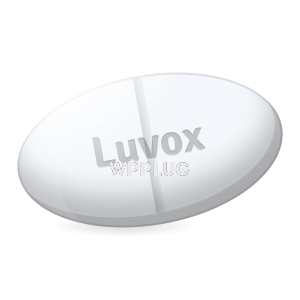
| Product dosage: 100mg | |||
|---|---|---|---|
| Package (num) | Per pill | Price | Buy |
| 30 | $3.14 | $94.27 (0%) | 🛒 Add to cart |
| 60 | $2.27 | $188.54 $136.39 (28%) | 🛒 Add to cart |
| 90 | $1.97 | $282.81 $177.51 (37%) | 🛒 Add to cart |
| 120 | $1.84 | $377.08 $220.63 (41%) | 🛒 Add to cart |
| 180 | $1.69 | $565.63 $303.87 (46%) | 🛒 Add to cart |
| 270 | $1.59
Best per pill | $848.44 $428.23 (50%) | 🛒 Add to cart |
| Product dosage: 50mg | |||
|---|---|---|---|
| Package (num) | Per pill | Price | Buy |
| 30 | $1.81 | $54.16 (0%) | 🛒 Add to cart |
| 60 | $1.37 | $108.31 $82.24 (24%) | 🛒 Add to cart |
| 90 | $1.23 | $162.47 $110.32 (32%) | 🛒 Add to cart |
| 120 | $1.15 | $216.62 $138.40 (36%) | 🛒 Add to cart |
| 180 | $1.08 | $324.93 $194.56 (40%) | 🛒 Add to cart |
| 270 | $1.03 | $487.40 $278.80 (43%) | 🛒 Add to cart |
| 360 | $1.00
Best per pill | $649.87 $361.04 (44%) | 🛒 Add to cart |
Synonyms | |||
More info:
Luvox: Effective OCD and Anxiety Symptom Control - Evidence-Based Review
Fluvoxamine, marketed under the brand name Luvox among others, is a selective serotonin reuptake inhibitor (SSRI) primarily prescribed for obsessive-compulsive disorder (OCD) and off-label for several anxiety-related conditions. It’s one of those workhorse medications in psychiatry that doesn’t get the flashy headlines of newer agents but has this remarkable depth of real-world clinical data supporting its use, particularly for the pure-O subtype of OCD where intrusive thoughts are the main issue.
clozaril
Clozaril represents one of the most clinically significant yet challenging psychotropic medications in modern psychiatry. As an atypical antipsychotic, its unique receptor profile and demonstrated efficacy in treatment-resistant schizophrenia have secured its position as a gold-standard intervention when other agents fail. What many clinicians don’t realize until they’ve prescribed it for years is how dramatically it differs from other antipsychotics in both mechanism and monitoring requirements. Clozaril: Superior Efficacy for Treatment-Resistant Schizophrenia - Evidence-Based Review 1.
cymbalta
Duloxetine hydrochloride, marketed under the brand name Cymbalta, represents a significant class of medication known as a serotonin and norepinephrine reuptake inhibitor (SNRI). It’s not a dietary supplement or medical device but a prescription pharmaceutical primarily indicated for major depressive disorder (MDD), generalized anxiety disorder (GAD), and several chronic pain conditions like diabetic peripheral neuropathic pain and fibromyalgia. Its development marked a shift from older antidepressants by targeting two key neurotransmitters simultaneously, which offered a different efficacy and side effect profile that we’ve found particularly useful in patients with comorbid pain and mood symptoms.
Esbiet: Slowing Disease Progression in Idiopathic Pulmonary Fibrosis - Evidence-Based Review
Pirfenidone, marketed under the brand name Esbriet, represents a significant advancement in the management of idiopathic pulmonary fibrosis (IPF). This orally administered antifibrotic agent specifically targets the underlying pathological processes of this progressive and ultimately fatal lung disease. Unlike traditional approaches that merely addressed symptoms, Esbriet works at the molecular level to slow disease progression by modulating multiple pathways involved in fibrosis development. 1. Introduction: What is Esbriet? Its Role in Modern Medicine Esbriet contains the active pharmaceutical ingredient pirfenidone, which belongs to the antifibrotic class of medications.
melatonin
Melatonin, an endogenous neurohormone synthesized primarily by the pineal gland, represents one of the most significant chronobiotic substances in clinical practice. Its molecular structure, N-acetyl-5-methoxytryptamine, belies its profound influence on circadian physiology. What began as a simple sleep aid has evolved into a sophisticated tool for managing circadian rhythm disorders, with applications spanning from jet lag to neurodegenerative conditions. The transition from prescription-only to over-the-counter status in many countries has dramatically increased its accessibility, though this has also created challenges in appropriate usage patterns that we’ll explore throughout this monograph.
Olanzapine: Effective Symptom Control for Schizophrenia and Bipolar Disorder - Evidence-Based Review
Olanzapine stands as one of the most clinically significant atypical antipsychotics developed in the last 30 years. Structurally, it’s a thienobenzodiazepine derivative, which gives it a unique receptor binding profile compared to older typical antipsychotics. We initially saw it as just another option for schizophrenia management, but over two decades of real-world use have revealed its complex benefits and challenges across multiple psychiatric conditions. 1. Introduction: What is Olanzapine? Its Role in Modern Psychiatry Olanzapine is an atypical antipsychotic medication approved for the treatment of schizophrenia, acute manic episodes in bipolar I disorder, and as maintenance treatment in bipolar disorder.
pirfenex
Pirfenex represents one of those rare instances where a repurposed generic drug fundamentally changed our approach to managing progressive fibrotic lung disease. When we first started using it off-label for idiopathic pulmonary fibrosis back in 2012, the standard protocol was essentially high-dose corticosteroids and supportive care - both of which did little to slow the relentless decline in pulmonary function. The transformation began when we noticed something peculiar in patients receiving this medication for other indications: their cough frequency diminished, their oxygen saturation stabilized, and most importantly, their forced vital capacity decline appeared to slow.
Plavix: Effective Prevention of Thrombotic Events in Cardiovascular Disease - Evidence-Based Review
Plavix, generically known as clopidogrel, is a cornerstone antiplatelet medication, not a dietary supplement or medical device, prescribed globally to reduce the risk of heart attack and stroke in patients with cardiovascular disease. It belongs to the thienopyridine class and works by irreversibly inhibiting the P2Y12 component of ADP receptors on platelet surfaces, preventing platelet activation and aggregation. This is critical in conditions like acute coronary syndrome, recent myocardial infarction, stroke, or established peripheral arterial disease, where platelet-rich thrombus formation can lead to catastrophic vascular events.
Requip: Effective Symptom Control for Parkinson's and Restless Legs Syndrome - Evidence-Based Review
Ropinirole is a non-ergoline dopamine agonist primarily prescribed for managing Parkinson’s disease symptoms and moderate-to-severe restless legs syndrome. As a selective D2 receptor agonist, it mimics dopamine’s effects in the brain, addressing the neurotransmitter deficiencies characteristic of these conditions. Available in both immediate-release and extended-release formulations, this medication represents a cornerstone in neurological therapeutics, particularly for patients experiencing motor fluctuations with levodopa therapy. 1. Introduction: What is Requip? Its Role in Modern Neurology Requip, with the active pharmaceutical ingredient ropinirole hydrochloride, belongs to the dopamine agonist class of medications.